Fan chart vs pedigree chart: which should you choose?
Both charts show the same thing: one person and the ancestors behind them. But they read very differently on a wall, and they run out of room at different points. Here's how to pick.
The short answer
- Pedigree chart for three to five generations, when you want it to be easy to read and to have room for dates and places. The best choice for a first family tree or a gift for a new baby.
- Fan chart for five to seven generations, when you want to show how deep your research goes in a compact, decorative shape. The favorite of family historians.
- Neither, if you want to show a couple and everyone who came after them. That's a descendant tree, covered below.
What a pedigree chart is
A pedigree chart starts with one person, the root, and branches out to their two parents, four grandparents, eight great-grandparents and so on. Each person gets a box or a name with a line connecting them to their parents. It's the layout most people picture when they hear "family tree".
There are two common orientations. The classic genealogist's version reads left to right, with the root on the left and each generation in a column further right. The "tree" version puts the root at the bottom and grows upwards, which looks more natural on a wall. TreeKeepsake offers both.
The catch is that each generation doubles:
| Generation | Who | People in it | Total |
|---|---|---|---|
| 1 | The root person | 1 | 1 |
| 2 | Parents | 2 | 3 |
| 3 | Grandparents | 4 | 7 |
| 4 | Great-grandparents | 8 | 15 |
| 5 | 2nd great-grandparents | 16 | 31 |
| 6 | 3rd great-grandparents | 32 | 63 |
| 7 | 4th great-grandparents | 64 | 127 |
In a pedigree chart, the outermost generation sets the width. Five generations means 16 boxes side by side; six means 32. Past five generations, a pedigree chart needs either a very large page or very small text.
Strengths: it's the easiest layout to read, there's room for years and places under each name, and the structure is obvious even to people who've never looked at a genealogy chart.
Weaknesses: it gets wide quickly, and the older generations, which are often the most interesting to researchers, end up squeezed into the smallest boxes.
What a fan chart is
A fan chart puts the root person at the center, or at the middle of the bottom edge, and arranges each earlier generation as a ring around them. Each ring is divided into segments, one per ancestor, with the father's line on one side and the mother's line on the other. A half-circle fan is the classic shape; TreeKeepsake also offers a 240° fan and a full circle.
The clever part is geometry. Each ring is further from the center than the last, so it's longer, and the space available grows with every generation. That's why a fan chart can hold six or seven generations on a single poster without the outer names becoming microscopic.
Strengths: it's compact for its depth, it's striking as a piece of wall art, and it shows at a glance which lines you've researched far back and where the gaps are.
Weaknesses: names in the outer rings run along or across the curve, so they're harder to read, especially for older eyes. Segments are narrow, so there's usually room for names and years but not for places.
Side by side
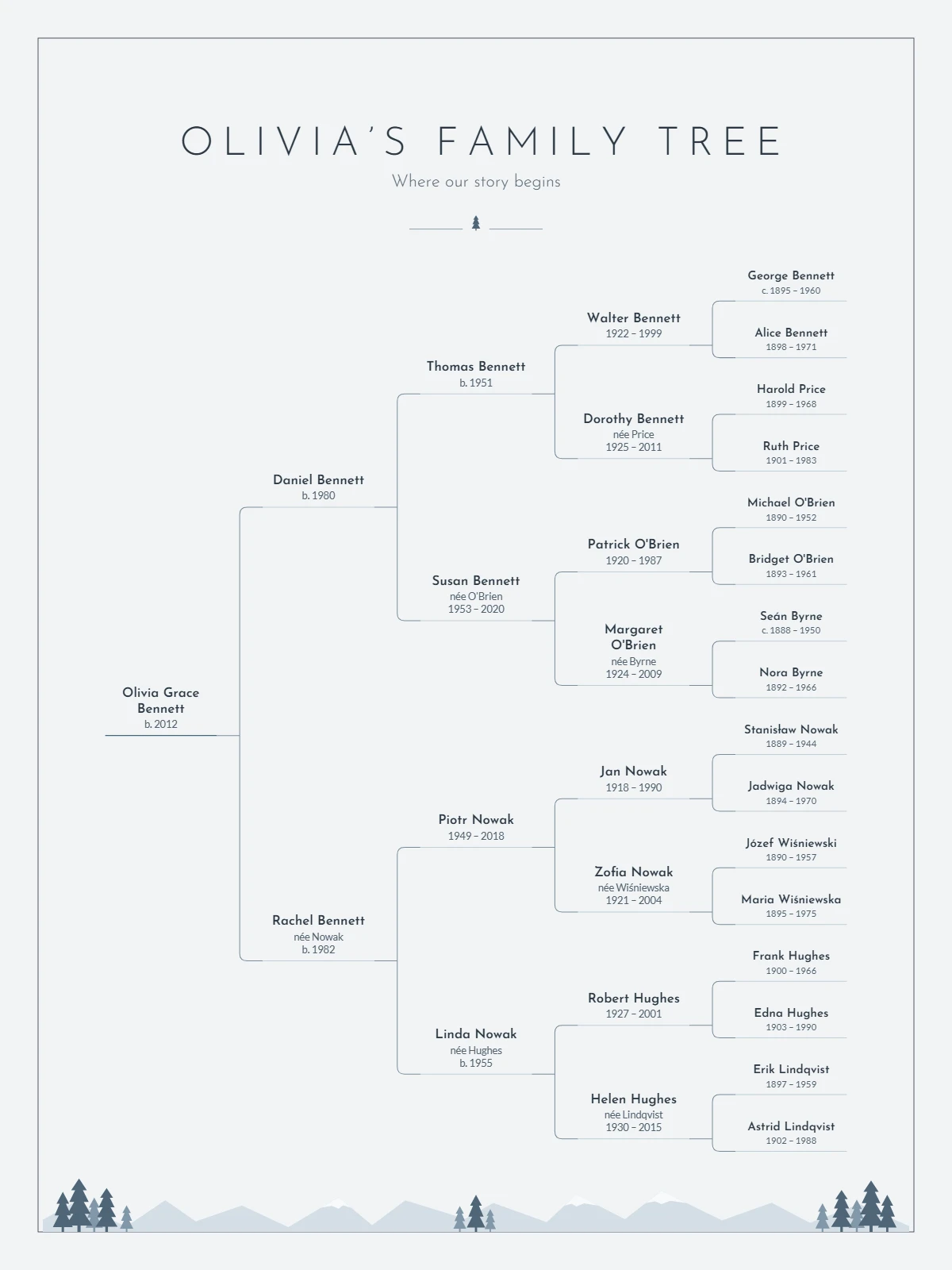
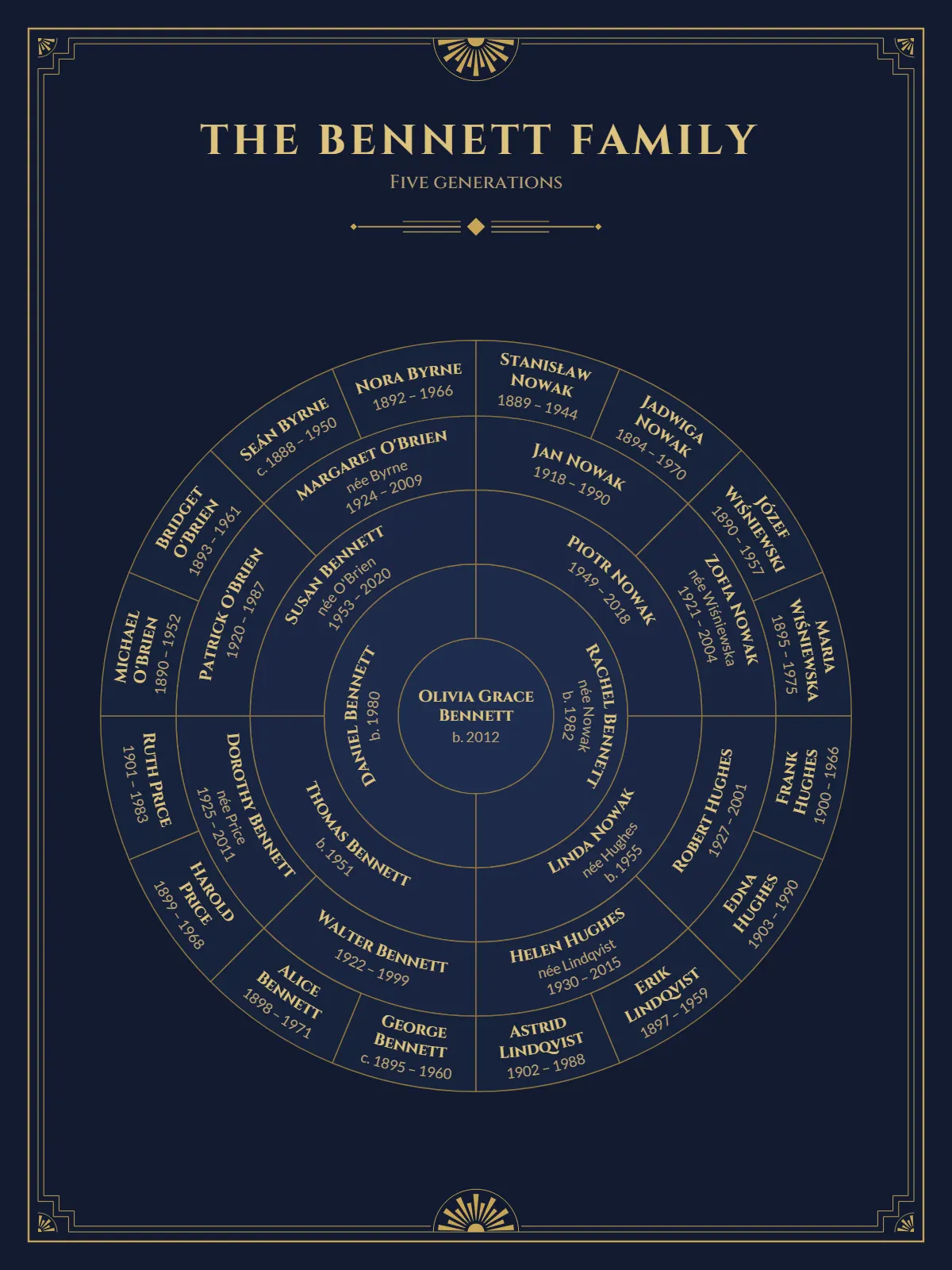
| Pedigree chart | Fan chart | |
|---|---|---|
| Sweet spot | 3–5 generations | 5–7 generations |
| Readability | Excellent | Good near the center, harder in the outer rings |
| Room for details | Names, years and places | Names and years |
| Look | Classic and orderly | Graphic and decorative |
| Page shape | Portrait (tree style) or landscape (left to right) | Landscape for a half fan, square-ish for a full circle |
| Best for | New babies, first trees, gifts | Family historians, deep research, statement pieces |
How big does the poster need to be?
As a rough guide for comfortable reading, a four-generation pedigree chart fits well on 11×14 inches (or A3), five generations want 16×20 or 18×24 inches (A2), and six generations really need 24×36 inches (A1). A fan chart with five generations works at 16×20 inches; six or seven generations deserve 18×24 or larger. If names would be too small at the size you've picked, TreeKeepsake tells you before you download.
Tips for a good-looking result
Pedigree charts
- For a wall, the tree style (root at the bottom, growing upwards) usually looks better than the left-to-right genealogist's layout, which suits a desk reference or a wide landscape frame.
- Show places for the first three generations if space is tight; that's where most families can still name the towns.
- Married women are traditionally shown under their birth surname in genealogy charts. Decide which convention your family prefers and apply it consistently.
Fan charts
- Keep details to names and years. The outer rings rarely have room for more, and a clean fan reads better than a crowded one.
- A half fan sits naturally in a landscape frame; a full circle suits a square or near-square frame with the root person in the middle.
- Look at the surnames around the outer edge. Every segment on the mother's side tends to carry a different family name, which makes a fan chart a striking record of how many families came together to make one person.
What about missing ancestors?
Almost every tree has gaps: a great-grandmother whose maiden name nobody knows, a line that stops at an orphanage record. Both layouts simply leave those spaces empty. In a pedigree chart a missing branch is easy to overlook; in a fan chart an empty segment stands out. Some researchers love that, because it shows exactly where to dig next.
When you want a descendant tree instead
Pedigree and fan charts look backwards from one person. A descendant tree looks forwards: it starts with a couple at the top and shows their children, grandchildren and great-grandchildren below. That's what you want for a grandparents' anniversary or a family reunion, where the point is to see everyone who came after. Its size depends on how many children each generation had rather than on doubling, so a family with many cousins may need a landscape page.
So which should you choose?
- A gift for a new baby: a four-generation pedigree chart.
- A gift for grandparents: a descendant tree.
- Showing off six or seven generations of research: a fan chart.
- You want birthplaces on the poster: a pedigree chart.
- A small frame or a narrow wall: a four-generation pedigree, or a five-generation fan.
Still undecided? Try both. Switching the chart type in the editor takes one click and the preview is free, so you can compare them with your own family's names before committing. For tips on the rest of the process, read how to make a family tree poster.